
There is a particular kind of person who organises everything. The dinner parties. The group chats. The one who remembers everyone’s birthdays, shows up with something thoughtful, and stays until the last conversation winds down.
Maybe you used to be that person.
Maybe, gradually, you still are, but with far less of an audience.
If your social world has quietly contracted over the past few years, if the group chats have gone dormant and the call list has grown shorter, you are not alone. And, more importantly, you are probably not broken.
What the research actually shows
Across decades of personality research using the Big Five model, one of the most consistent findings is that extroversion tends to decline as people age. This holds for both men and women, though the pattern plays out differently across genders.
But here is the nuance that matters: what is actually declining is not your capacity for connection. Two specific components of extroversion shift with age:
Sensation-seeking, the appetite for novelty and high-stimulation environments, and social dominance, the drive to be at the centre of the room, to hold social attention. What tends to remain stable, or even deepen, is warmth, empathy, and the quality of your closest relationships.
You are not losing interest in people. You are losing interest in all people, all the time.
Stanford psychologist Laura Carstensen’s work on Socioemotional Selectivity Theory explains this elegantly: as people age and their sense of time becomes more finite, they naturally begin to optimise social energy for meaning and quality rather than breadth and novelty.
Your social circle is not shrinking by accident. It is being edited.
The distinction that changes everything
This is where I want to slow down, because most people miss it entirely.
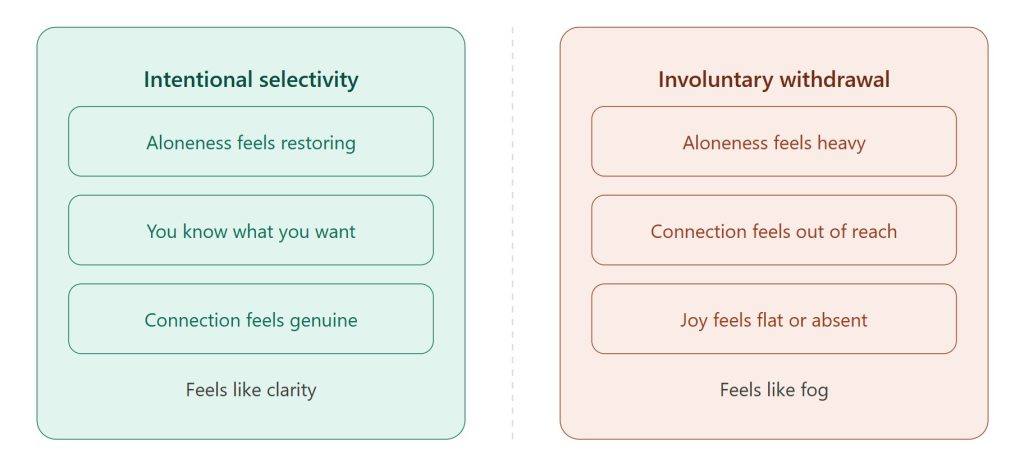
There is a significant difference between someone who is pulling back because they are choosing depth over breadth, and someone who is withdrawing because they are lonely, depressed, grieving, or quietly losing themselves.
From the outside, they can look almost identical. Both cancel plans. Both are harder to reach. Both seem to need less company.
The diagram above captures the difference in practical terms. Intentional selectivity feels like clarity, you know what you want, the quiet restores you, and when you do connect, you are fully there. Involuntary withdrawal feels like fog, you want connection but cannot seem to reach for it, the good moments feel flat, and the things you used to love no longer land the same way.
One is a maturation of your social self. The other is a signal worth paying attention to.
A coaching lens: what are you actually choosing?
This is the kind of question I bring into coaching conversations regularly, because the answer shapes everything else.
If you are in intentional selectivity mode, the work is about protecting and deepening the relationships that genuinely matter. It is about being honest with yourself when you say no to something, so the yeses carry real weight. It is about designing a social life that aligns with your values rather than the one you inherited from an earlier version of yourself.
If you recognise the fog, the flatness, the sense of wanting connection but not being able to reach for it, that deserves a different kind of attention. It is not a character flaw and it is not permanent, but naming it clearly is the first step toward changing it.
The question worth sitting with is this: when you decline an invitation or let a conversation go quiet, does it feel like a choice or does it feel like gravity?
The edit is yours to make
Your social self is not fixed. It is something you can shape with intention, the same way you shape your training, your recovery, or your nutrition. You do not have to default to whatever pattern got established in your twenties.
The most connected people I know are not necessarily the most social. They are the ones who have gotten deliberate about where their energy goes, who they let in, and what kind of presence they bring to the relationships they choose to maintain.
That kind of intentionality is a coaching skill as much as it is a life skill. And it is something you can build.